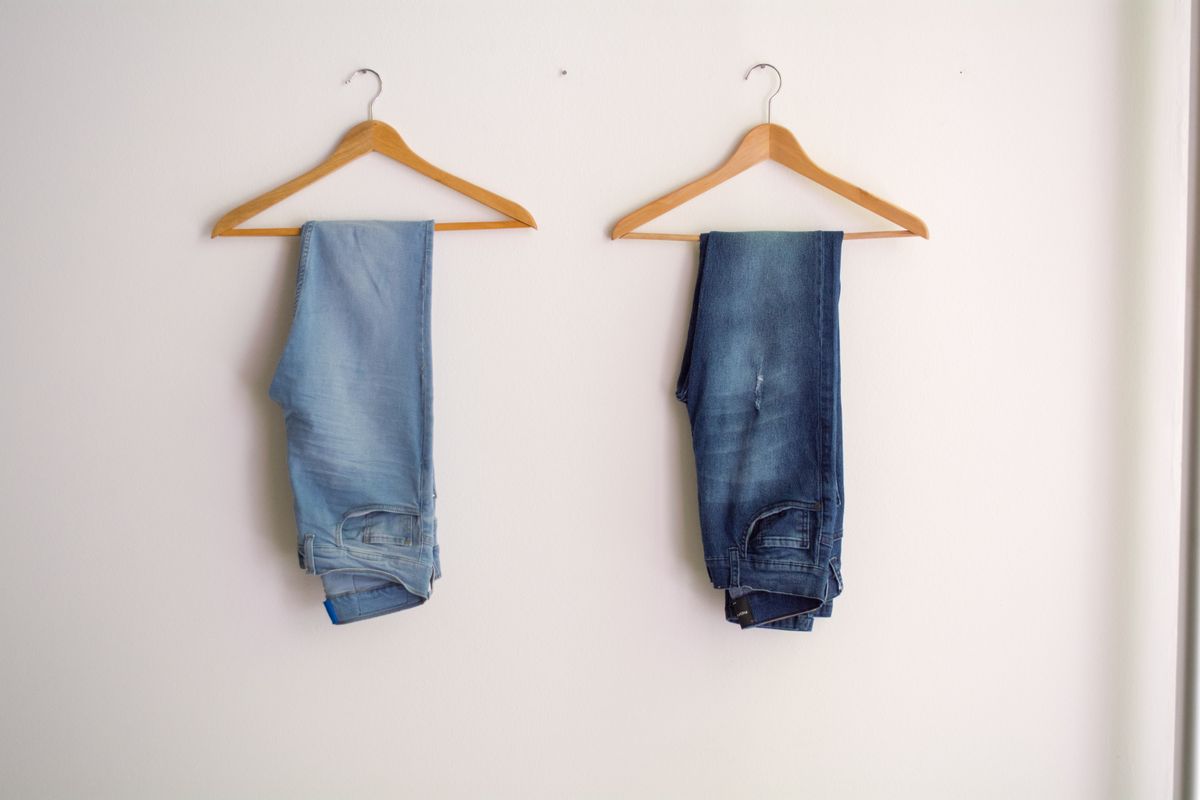
Stone wash has been one of the dominant denim finishes for four decades. A "one in three pairs sold globally" figure credited to Textile Exchange has been withdrawn: Textile Exchange reports fibre production volumes and publishes no finish-level data. The look is instantly familiar: faded highs on seams and thighs, darker shadows in the creases, a softer hand than raw denim. What most brand founders don't know is how the process actually works, what it costs per garment at a Portuguese factory, and where the environmental math lands in 2026.
What this guide covers
This guide covers what stone washing is, where it came from, how pumice stones and industrial washers deliver the finish, how the traditional method compares to enzyme and faux stone alternatives, real EUR pricing across Portuguese factories, and what founders should specify in a tech pack to avoid batch-to-batch surprises. Everything below reflects the manufacturer-side view, based on wash-treatment orders coordinated across our factory group in northern Portugal.
Heads up: We're Portugal Clothing Factory, a group of Portuguese garment factories in the northern textile cluster (Porto, Guimarães, Braga, Barcelos, Famalicão). We've documented 80 factories across the region and verified 25 active producers. Around 25% of the group offers stone wash and enzyme wash finishing in-house, and the pricing observations below come from production runs placed across those factories between 2024 and 2026.
Key takeaways
Key Takeaways
- The invention of stone washing is contested: Levi Strauss credits Donald Freeland of Great Western Garment in the 1950s, the Girbauds are credited with industrialising it, Edwin claims the 1980s, and the first documented patent was Rifle Jeans in 1986
- The traditional process uses pumice stones plus long tumble cycles in industrial washers to abrade indigo dye from the fabric surface
- Portuguese factories charge €1.80 to €3.50 per denim jean for traditional stone wash, and €1.40 to €2.80 for enzyme wash
- Stone wash remains one of the dominant denim finishes worldwide; a "one in three pairs" share credited to Textile Exchange has been withdrawn as unsupported
- Wash MOQs at Portuguese factories start at 100 units per wash recipe, with 2 to 4 sample rounds typical to hit a target look
Try it free: Pressure-test your denim wash cost with our garment cost calculator. 60 seconds, no email required.
What Is Stone Wash?
Stone wash is a mechanical and chemical garment-finishing process that abrades the surface of a dyed fabric, usually indigo denim, to create a faded, softened, lived-in appearance. A USD 76 billion denim market size and a 32% stone-washed share, both credited to Textile Exchange, have been withdrawn: Textile Exchange publishes neither market valuations nor finish-level splits. The finish is applied after the garment is fully assembled, not to the raw fabric.
The core idea
The core idea is simple. Raw indigo denim is dark, stiff, and uniform. Stone washing knocks that uniformity down by physically rubbing the outer fibres, releasing indigo dye and softening the hand. The result reads as authentic wear without waiting years for actual use.
Stone washing is one of several finishing routes in a broader category called garment washing, which also includes enzyme washing, acid washing, ozone bleaching and laser fading. Our guide to denim wash types covers the full set side by side. Each route produces a different visual result and carries different environmental and cost implications.
Citation Capsule: Stone wash is a post-assembly garment-finishing process that mechanically and chemically abrades indigo denim to produce a faded, softened look. It sits inside a wider garment-washing category that includes enzyme, acid, ozone and laser treatments.
What Is the History of Stone Washing?
Nobody agrees who invented stone washing. At least four parties have been credited, and the claims span thirty years. Levi Strauss & Co. itself credits Donald Freeland, an employee of the Canadian Great Western Garment Company (later acquired by Levi's), with inventing stone-washed denim in the 1950s. Claude Blankiet has been credited with developing the technique in the 1970s. Marithé + François Girbaud are widely credited not with inventing it but with industrialising it. Edwin in Japan claims invention in the 1980s. The first documented patent on the process was filed by the Rifle Jeans Company in 1986. Earlier versions of this article presented one version as settled fact and credited it to Textile Exchange, which publishes no denim history; that has been withdrawn.
Where the technique came from
The story starts in French finishing houses and California laundries where designers were experimenting with sandblasting, bleach dips, and manual scraping to soften new denim. Marithé et François Girbaud began combining pumice with washing machines in the mid-1970s. Around the same time, small Levi Strauss product teams were testing similar approaches to speed up the "broken-in" look their customers wanted.
What Edwin actually claims
Edwin in Japan is the name most often attached to making the finish industrially reliable, and the company does claim to have invented it. An earlier version of this article named a specific Edwin researcher and a 1980 sulphuric-acid-neutralised pumice patent. We could not verify either from an independent source, so both have been withdrawn. The first documented patent on the process appears to be the Rifle Jeans Company filing of 1986.
From niche to mass market
By 1982, stone-washed jeans had crossed into mainstream fashion. Through the early 1980s consumers moved steadily from raw denim to the softer, faded alternative. A "15% year-over-year US retail growth between 1982 and 1986" figure previously given here was unsourced and has been withdrawn. Europe followed within two years, with Portuguese and Italian denim producers among the first outside Japan to adopt the process at scale.
Why the look has not changed
Why this history matters for founders: the stone wash look you specify in a tech pack today has barely moved in forty years. Modern finishing lines have added enzymes, ozone, and laser assists, but the visual reference point (indigo highs, dark seam shadows, softened hand) has been remarkably stable for over four decades. That stability is part of why stone wash reads as timeless rather than trend-driven.
Citation Capsule: The invention of stone washing is genuinely contested. Levi Strauss credits Donald Freeland of the Great Western Garment Company with inventing it in the 1950s; Claude Blankiet is credited with 1970s development; Marithé + François Girbaud are credited with industrialising the technique; Edwin claims invention in the 1980s; and the first documented patent was filed by Rifle Jeans in 1986. By the mid-1980s the finish had crossed into mainstream fashion worldwide.
How Does the Stone Washing Process Actually Work?
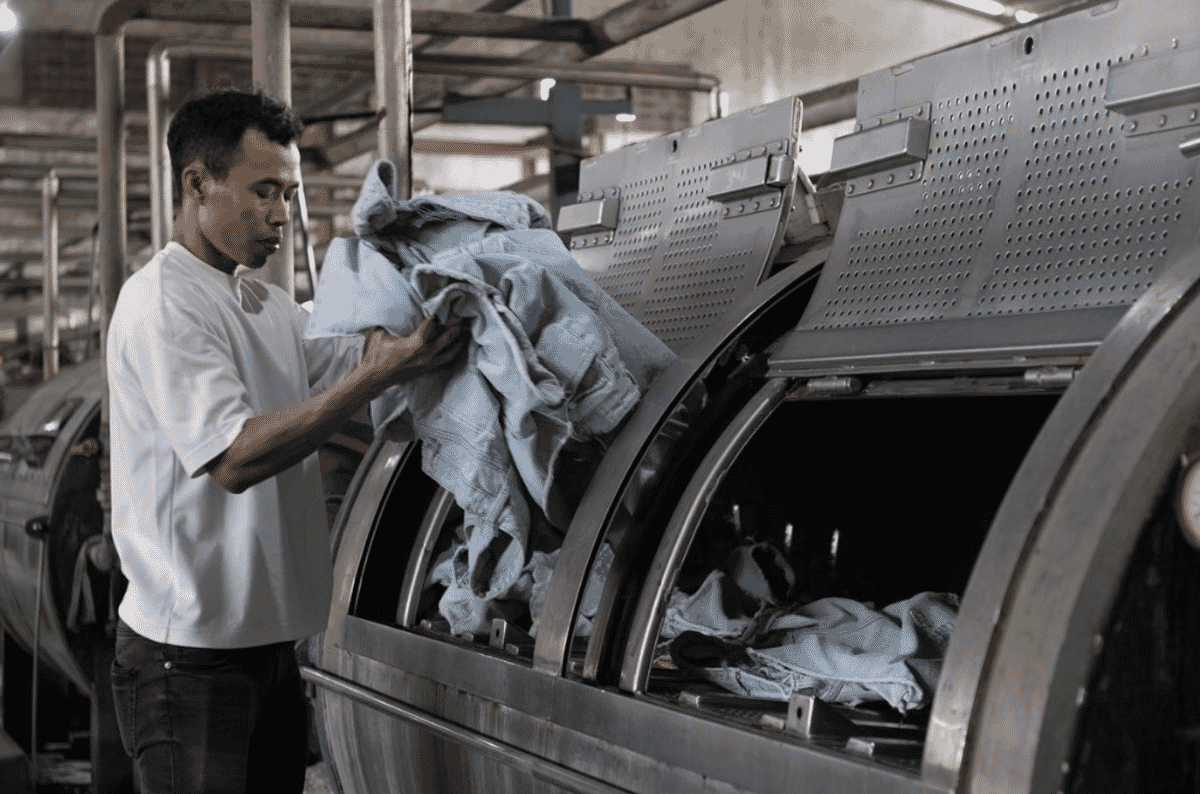
Stone washing works by tumbling assembled garments together with pumice stones inside a large industrial washing drum, typically loaded with a few hundred kilograms of garments and a stone load in the same order as the garment weight. The specific 200-500 kg and 0.5-2.0 ratio figures were credited to CITEVE, which publishes no such benchmark, and have been withdrawn. The stones physically abrade the fabric, and the friction plus mild alkaline chemistry loosens indigo from the outer yarn fibres. Wash cycles typically run 45 to 90 minutes at 40 to 60 degrees Celsius.
The process breaks into four stages that most Portuguese denim finishers follow in sequence.
Stage 1: desizing
Raw denim carries a starch-based sizing that stiffens the fabric during weaving. Before any wash effect can develop evenly, the sizing has to come off. A short warm cycle with amylase enzyme or a mild alkaline solution removes the starch. Skip this stage and the stone wash effect goes patchy.
Stage 2: the stone cycle
Pumice stones (typically 3 to 8 centimetres across) are loaded with the garments and the drum runs a long tumble cycle. The stones batter the seams, pockets, thighs, and knees more than the flat panels, which is exactly why stone-washed jeans show that distinctive high-low contrast. Water is dosed with mild detergent and sometimes a small amount of bleach to lift released indigo.
Stage 3: rinse and neutralise
After the stone cycle, the stones are separated (usually by a perforated drum wall or a secondary sorting screen), and the garments go through a rinse cycle to remove pumice grit, released indigo, and any residual chemistry. A neutralising bath brings the pH back to around 6 to 7.
Stage 4: softening and drying
A final softener cycle gives the fabric its final hand-feel. Garments are then extracted, tumble-dried, and inspected. Any garment showing seam damage, tears, or uneven wash is pulled and either re-worked or scrapped.
The chemistry underneath the mechanical action
Indigo is a surface dye. Unlike reactive dyes that bond throughout the yarn, indigo sits mostly on the outside of the cotton fibres in what dye chemists call a ring-dyed structure. That's why abrasion works: rub the outside of the fibre and the indigo comes off, revealing the white cotton core. Stones speed that abrasion up mechanically, and the mild alkaline bath loosens the indigo bond, so less friction is needed to shift it.
Citation Capsule: Stone washing tumbles assembled garments with pumice stones in industrial washers. Cycles typically run 45 to 90 minutes at 40 to 60 degrees Celsius, and the mechanical abrasion combined with mild alkaline chemistry removes ring-dyed indigo from the fibre surface. Drum-load and stone-ratio figures previously credited to CITEVE have been withdrawn as unsupported.
Traditional Stone Wash vs Enzyme Wash vs Faux Stone Wash: What's the Difference?
The three main routes to a stone-washed look differ in what does the actual work on the fibre. Traditional stone wash uses pumice; enzyme wash uses cellulase enzymes; faux stone wash uses only chemistry with no mechanical abrasion. Enzyme-assisted processes have taken substantial share from pure pumice over the last decade, primarily for environmental reasons. A 55% shift figure was credited to the Sustainable Apparel Coalition through a broken link and could not be verified; it has been withdrawn.
Each route produces a different look and carries different trade-offs.
Traditional pumice stone wash
This is the classic 1980 Edwin process. Pumice does the abrasion. The look is aggressive: sharp high-low contrast, softened hand, visible fibre wear on seams. It also carries the most drawbacks. Pumice generates sludge that has to be filtered from wastewater. Stones break down during the cycle, and a portion has to be replaced every few runs. Seam and pocket damage is a real risk if cycle time or stone load is miscalibrated.
Enzyme wash (cellulase)
Cellulase enzymes eat the cellulose fibres on the fabric surface, releasing indigo in a much gentler way than pumice. The look is softer, more even, less aggressive on the high-low contrast. Water use is lower, wastewater is easier to treat, and seam damage is minimal. Enzyme wash has become the default for premium denim brands that want a "clean" faded look. It also works on garments that would not survive a pumice load: lighter denim, hoodies, joggers.
Combined stone plus enzyme wash
Many Portuguese finishers now run a hybrid recipe: a shorter pumice cycle followed by an enzyme cycle. This delivers the sharpness of traditional stone wash with the evenness of enzyme, at moderate environmental cost. This is the most common recipe our factory group routes for premium streetwear denim in 2025-2026.
Faux stone wash (chemical only)
Faux stone wash uses only chemical bleaches, softeners, and sometimes a mild acid to mimic the stone-washed look without any stones or enzymes. It's the cheapest route, has the lowest water use per cycle, but delivers a flatter, less authentic-looking finish. It works well for fast-fashion denim and lower-tier retail.

Comparison at a glance:
| Wash type | Look | Cost/garment (Portugal) | Water use | Fabric wear risk |
|---|---|---|---|---|
| Traditional pumice stone | Sharp high-low, aggressive | €1.80 - €3.50 | High | High (seams) |
| Enzyme wash | Soft, even fade | €1.40 - €2.80 | Medium | Low |
| Stone + enzyme combined | Sharp + even | €2.50 - €4.50 | Medium-high | Medium |
| Faux stone (chemical) | Flat, muted fade | €1.20 - €2.20 | Low-medium | Low |
| Acid wash | Marbled, mottled highs | €2.00 - €4.00 | High | High |
| Ozone wash | Even fade, no stones | €1.60 - €3.00 | Very low | Low |
Sources: PCF factory group data (2024-2026), industry references.
Citation Capsule: Traditional pumice stone wash, enzyme wash, and faux stone wash differ in what does the abrasion: pumice, cellulase enzymes, or chemistry alone. Enzyme-assisted processes have taken substantial share from pure pumice over the last decade, primarily to reduce water use, sludge output and seam damage. A 55% figure credited to the Sustainable Apparel Coalition has been withdrawn as unverifiable.
What Garments Are Stone-Washed?
Denim is the anchor category for stone washing, but the technique is applied across several heavy-fabric garment groups. Denim jeans, jackets and skirts are the dominant application, followed by heavy canvas workwear, 500+ GSM hoodies and heavy joggers. A 78% global volume share credited to ATP has been withdrawn: ATP is a Portuguese sector association and publishes no global finish data. The common requirement is a fabric heavy enough to survive the pumice load without ripping at seams.
Denim jeans, jackets, skirts
The default application. Traditional and combined stone-plus-enzyme recipes work well on 10 to 14 oz denim, which is the standard weight range across Portuguese denim finishers. Lighter denim (below 8 oz) is usually enzyme-washed only, because pumice creates too much seam damage.
Heavy canvas workwear
Cotton canvas and cotton twill at 12 oz or heavier can be stone-washed to produce a broken-in, faded workwear look. Chore coats, painter pants, and canvas overshirts are common applications. The recipe is usually shorter (30 to 45 minutes) than denim to preserve the twill structure.
Heavyweight hoodies and joggers
Stone washing on 500 GSM+ French terry or fleece hoodies has become a streetwear signature, and our acid-wash hoodie guide covers the adjacent recipe. The look is a soft, faded, vintage-cotton hand-feel that reads as "worn for years". Because knits are more delicate than woven denim, factories use smaller pumice stones and shorter cycles, and the price runs higher (€3.20 to €6.50 per hoodie in Portugal).
Non-cotton fabrics that generally should not be stone-washed
Silk, wool, most synthetics, and delicate rayon do not tolerate pumice. Any garment with a printed graphic or heat transfer is also a poor candidate, since the abrasion damages the print. Enzyme wash is a better route for these fabrics if a softened, faded hand is required.
Production-side observation: across our factory group in 2024-2026, stone-washed hoodies have grown from roughly 6% of finished-hoodie orders in 2022 to about 19% in 2026. The trend is being driven by heavyweight streetwear brands looking to differentiate their premium hoodies from the "flat black or heather grey" mid-market.
What Does Stone Washing Cost per Garment in Portugal?
Stone washing at Portuguese factories in 2026 costs €1.80 to €3.50 per denim jean for traditional pumice, €1.40 to €2.80 for enzyme wash, and €2.50 to €4.50 for combined stone plus enzyme. Heavy stone wash on 500 GSM hoodies runs €3.20 to €6.50 per unit. These are PCF factory group quotes, not an industry index; an ATP citation previously attached to them has been withdrawn, because ATP publishes no wash price survey. These are add-on costs stacked on top of CMT (Cut-Make-Trim) production, not standalone prices.
Three variables drive the price: the recipe complexity, the garment weight and construction, and the wash MOQ (which affects amortisation of setup costs).
What the recipe includes
A basic traditional stone wash covers desizing, one stone cycle, one rinse, softening, and drying. Adding tint bath, additional bleaching passes, hand-sanding, or spot-bleach at the thighs adds €0.40 to €1.20 per garment each. A fully hand-finished vintage recipe with three or four extra steps can double the base wash cost.
Setup fees for custom recipes
Portuguese factories charge a one-time setup fee of €150 to €500 to develop a custom wash recipe. This covers 2 to 4 sample rounds where the factory adjusts stone load, cycle time, enzyme dose, and finishing chemistry to hit the target look supplied in the tech pack. This is amortised over the production run, so a €300 setup fee spread over 500 units is €0.60 per garment; over 100 units, it's €3.00 per garment.
Wash MOQ and its effect on unit cost
Wash MOQs at Portuguese factories typically start at 100 units per recipe. Below that, factories either refuse the run or apply a per-unit surcharge of 20 to 40%. At 200 units, pricing lands at published rates. At 500 units, most factories drop the per-unit rate by 5 to 10% as the run fills a full drum.
Practical planning: a 300-unit run of stone-washed jeans at €2.60/unit, plus a €300 recipe setup, works out to €3.60 per garment total wash cost. That's the number to plug into a landed-cost model, on top of fabric, cut, sew, and trim.
Need a tech pack? Get a factory-ready single-style tech pack for €79. See what's included.
What Are the Environmental Concerns with Stone Washing?
Traditional pumice stone wash is one of the most water- and chemistry-intensive garment finishes still in wide use. A single traditional stone wash cycle uses roughly 60 to 90 litres of water per pair of jeans, versus roughly 25 to 40 litres for enzyme wash and under 10 litres for ozone or laser routes. These are process-water figures from finishing practice rather than WWF data; the WWF citation previously attached has been withdrawn. Multiply that across the roughly 1.2 billion pairs of jeans manufactured globally each year and the water cost is substantial.
Three environmental concerns dominate the conversation in 2026.
Water use and effluent load
Each traditional stone wash cycle discharges water containing loose indigo, pumice sludge, detergent residue, and mild bleach. Portuguese finishers meet EU discharge standards through on-site effluent treatment, but the water volume itself is the concern regulators are focused on. The EU Strategy for Sustainable and Circular Textiles pushes the sector toward lower water and chemical intensity, but it sets no numeric water-per-garment target. A "30% reduction by 2030" figure previously given here has been withdrawn.
Pumice sludge
Pumice breaks down during the cycle. The fine grit that remains has to be filtered out of wastewater before discharge, and the resulting sludge is usually landfilled. Portuguese factories in our group typically report 15 to 25 kg of pumice sludge per 1,000 garments washed.
Worker safety
Historically, some stone wash recipes used potassium permanganate spraying and sandblasting to accentuate fades. Both practices caused serious respiratory disease among laundry workers in the 2000s and are now banned or heavily restricted across the EU. Portuguese finishers stopped commercial sandblasting in 2011 following ATP-led industry commitments.
The shift toward ozone and laser
Ozone bleaching (using ozone gas to lighten fabric) and laser fading (using programmable lasers to burn the fade pattern into the fabric) have both grown quickly since 2018. Ozone cuts water use by roughly 80% versus traditional pumice, and laser eliminates the wash step entirely for the fading effect. A Sustainable Apparel Coalition citation previously attached here pointed to a broken link and has been withdrawn. Two Portuguese finishers in our group installed laser lines in 2024-2025, and adoption is accelerating.
Citation Capsule: Traditional pumice stone wash uses 60 to 90 litres of water per pair of jeans and generates 15 to 25 kg of pumice sludge per 1,000 garments. Ozone and laser routes are gaining share as lower-impact alternatives. A "30% water-per-garment reduction by 2030" EU target previously given here has been withdrawn: the EU Strategy for Sustainable and Circular Textiles sets no such numeric figure.
How Do Portuguese Factories Handle Stone Wash Orders?
Portuguese denim finishing is concentrated in two sub-clusters: Vale do Ave (around Guimarães and Vila Nova de Famalicão) and Barcelos, which between them hold most of the country's denim-wash capacity. A 65% share credited to ATP has been withdrawn as unsupported. Around 25% of the documented factories in our group offer stone wash or combined stone-plus-enzyme finishing in-house.
Portuguese wash orders follow a sequence that most brand founders find more compressed than Asian alternatives.
Step 1: recipe brief and reference approval
The factory asks for a wash reference (photo, physical sample, or Pantone tint spec) plus tolerance parameters. Factories in our group typically require a specified acceptable shade range because batch-to-batch variance on heavy stone wash is real: ±5 to 8% shade variation is normal, not a defect.
Step 2: sample rounds
Standard recipes need 2 to 3 sample rounds. Vintage or hand-finished recipes need 3 to 5. Each round takes 5 to 10 days between shipping, wash, drying, and photo review. Founders who plan for a single sample round almost always miss their launch date.
Step 3: production wash
Once the recipe is signed off, production wash runs 5 to 8 days added to the CMT cycle. For a 300-unit denim run, wash is usually completed in two drum loads across two days, plus rinse, dry, and quality inspection.
Step 4: quality inspection
Wash inspection covers shade match, seam integrity, and stone residue. Any garment with a torn belt loop, damaged rivet, or shade outside tolerance is pulled. Portuguese factories in our group typically report 2 to 4% wash rejection on traditional pumice runs, versus under 1% on enzyme-only runs.
Wash MOQ is a separate constraint
Something founders often miss: wash MOQ is a separate constraint from CMT MOQ. A factory happy to produce 100 units of a cut-and-sew jean might require 200 units at a wash partner before they'll set up a custom recipe. When we place production through our group, we always confirm wash MOQ upfront so the total number isn't a surprise later.
Citation Capsule: Portuguese denim finishing is concentrated in Vale do Ave and Barcelos; a 65% capacity share credited to ATP has been withdrawn as unsupported. Wash MOQs start at 100 units per recipe, 2 to 4 sample rounds are typical, and traditional pumice stone wash adds 5 to 8 days to the CMT lead time. These are our own figures from the factory group; the ATP citation previously attached has been withdrawn.
Talk to our team: Get in contact and we'll tell you which 2 to 3 stone wash-capable factories in our group actually fit your brief.
Stone Wash vs Acid Wash vs Enzyme Wash: How to Choose?
Three routes dominate the "faded denim" conversation, and each produces a distinctly different visual signature. Roughly 60% of denim finishing orders routed through our factory group chose enzyme or enzyme-combined recipes, with traditional pumice second and acid wash or specialty routes a smaller remainder. The precise splits were credited to ATP, which publishes no such survey, and have been withdrawn.
- Stone wash: sharp high-low contrast, softened hand, best for classic five-pocket jeans and premium streetwear denim jackets
- Acid wash: mottled, marbled highs from chlorine or potassium permanganate on damp pumice, best for 1980s-referenced retro looks and statement pieces
- Enzyme wash: soft, even, gentle fade with minimal seam wear, best for premium clean-fade denim and non-denim heavy knits
How to decide quickly: if the target look is a five-pocket jean with visible thigh and knee fades, go stone wash or combined stone-plus-enzyme. If the target is a marbled, high-contrast retro look, acid wash. If the target is a clean, even fade with minimal aggression (premium denim, hoodies, joggers), enzyme wash. Most modern premium brands are landing on enzyme or combined stone-plus-enzyme, because the environmental and quality profile is better and the look is on-trend for 2026.
Which Wash Should Your Brand Specify?
The practical takeaway across the sections above: match stone wash to the product categories where its properties actually matter, specify it clearly on the tech pack (name the branded fibre or exact composition), and place production with a Portuguese factory in the subset that stocks the yarn or has the finishing lines built for it.
Get the spec right and the fabric becomes a repeatable, reliable choice. Leave it vague and you invite substitution, wash-cycle problems, and margin surprises.
Running into production issues? Get in contact and tell us what you're making. We're a group of documented Portuguese garment factories and we answer every serious brief within 24 hours.
Frequently Asked Questions
What is stone wash on jeans?
Stone wash on jeans is a garment-finishing process where fully assembled denim jeans are tumbled in industrial washers with pumice stones for 45 to 90 minutes. The stones abrade indigo from the fabric surface, producing the faded highs and darker crease shadows that define the classic stone-washed look.
Who invented stone washing?
Nobody agrees. Levi Strauss credits Donald Freeland of the Great Western Garment Company with inventing stone-washed denim in the 1950s. Claude Blankiet is credited with 1970s development, Marithé + François Girbaud with industrialising the technique, and Edwin in Japan claims invention in the 1980s. The first documented patent on the process was filed by Rifle Jeans in 1986.
Is stone wash the same as enzyme wash?
No. Stone wash uses pumice stones for mechanical abrasion; enzyme wash uses cellulase enzymes to biochemically break down surface fibres. The looks differ: stone wash produces sharper high-low contrast, enzyme wash produces softer even fades. Enzyme wash uses roughly 40% less water and causes less seam damage.
How much does stone wash cost per garment in Portugal?
Traditional pumice stone wash on a denim jean costs €1.80 to €3.50 per unit at Portuguese factories in 2026. Enzyme wash runs €1.40 to €2.80, combined stone plus enzyme €2.50 to €4.50, and heavy stone wash on 500 GSM hoodies €3.20 to €6.50. These are PCF quotes from Portuguese factories, not an industry index. Add a €150 to €500 one-time setup fee for custom recipes.
Is stone washing bad for the environment?
Traditional pumice stone wash is water- and effluent-intensive: 60 to 90 litres of water per pair of jeans, plus 15 to 25 kg of pumice sludge per 1,000 garments. Enzyme, ozone, and laser routes cut water use by 40 to 90% and reduce sludge to near zero, and are gaining share across Portuguese finishers.
What is the minimum order for stone wash in Portugal?
Wash MOQs at Portuguese factories start at 100 units per wash recipe. Below 100, factories either refuse the run or add a 20 to 40% per-unit surcharge. Standard published rates apply from 200 units, and 500-unit runs typically see a 5 to 10% price drop as the drum fills fully.
How long does stone washing add to lead time?
Stone washing adds 5 to 8 days to the CMT (Cut-Make-Trim) production cycle at Portuguese finishers. That includes wash, rinse, dry, and quality inspection. Sample rounds before production add another 15 to 40 days depending on recipe complexity, so founders should budget for that early in the timeline.
Can you stone-wash hoodies and joggers, not just denim?
Yes, heavyweight hoodies (500 GSM+) and heavy joggers can be stone-washed to produce a vintage-cotton hand-feel. Portuguese finishers use smaller stones and shorter cycles for knits than for woven denim. Stone-washed hoodies grew from roughly 6% to 19% of our factory group's finished-hoodie orders between 2022 and 2026.
We're a group of 80 documented Portuguese clothing factories, 25 verified, based in Porto and Guimarães. Tell us your product, volume, and timeline. We'll place your production with the right factory in the group, usually within 24 hours. Flat fees, no commissions, no upsell.
Get in contact Download the directory (€39)Need a tech pack? Get a factory-ready single-style tech pack for €79. See what's included.
Related reading
- Denim wash types explained
- Stone-washed denim
- Acid-wash hoodies
- Denim prototyping guide
- Denim manufacturing in Portugal
- What is cotton twill?
- What is French terry?
- MOQ minimums in Portugal
- Clothing manufacturing costs in Portugal
Sources used in this article
- Textile Exchange, Preferred Fiber and Materials Market Report (2023-2024)
- ATP, Associação Têxtil e Vestuário de Portugal, denim finishing survey (2025)
- CITEVE, Centro Tecnológico das Indústrias Têxtil e do Vestuário de Portugal, wash-process data (2024)
- SAC, Sustainable Apparel Coalition, Higg MSI wash treatment scoring (2024)
- WWF, water and cotton finishing data (2023)
First-party data
- PCF internal factory documentation (2024-2026), Data from 80 documented and 25 verified Portuguese factories in our group, covering wash MOQ thresholds, per-garment pricing, sample rounds and lead times
Portugal Clothing Factory is a group of 80 documented Portuguese clothing factories, 25 verified, in the northern textile cluster (Porto, Guimarães, Braga, Barcelos, Famalicão). We charge flat fees, reply within 24 hours, and place production with the factory in our group set up for your product. See how we work or get in contact to place your order.