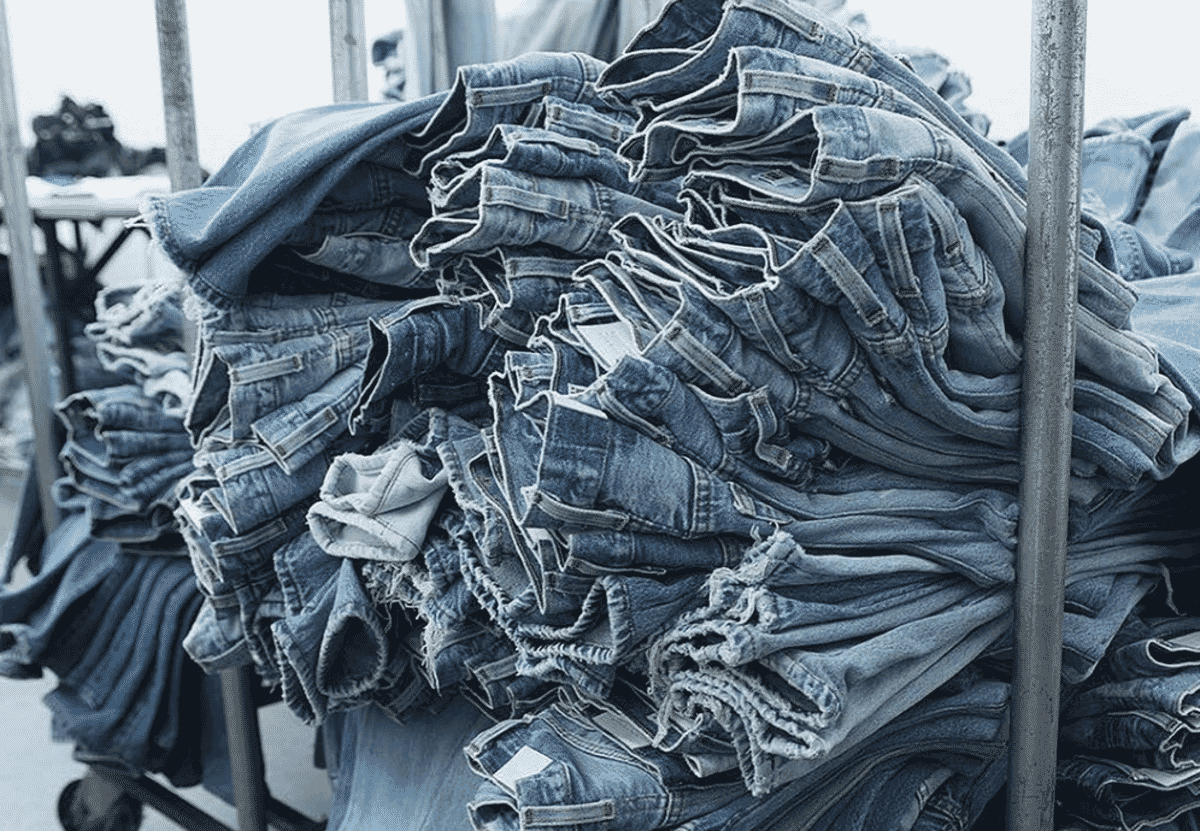
Denim washing is the single production step that most defines how a pair of jeans looks and feels. It is also the step that consumes the most water, energy, and time in denim production. Portuguese wash houses run four major processes on any given production week: rinse, stone wash, enzyme wash, and ozone wash. Each has its own cost, timeline, and sustainability profile. Textile dyeing and treatment are often said to account for up to 20% of industrial water pollution, a figure published in the Ellen MacArthur Foundation report A New Textiles Economy (2017) and usually traced to a World Bank estimate whose original source has since been questioned. Treat it as an order of magnitude rather than a measurement. Denim washing sits at the heavy end of that footprint by garment category.
What this guide covers
This guide breaks down what stone wash, enzyme wash, ozone wash, and rinse each actually do to a jean. It covers what they add to the per-pair cost, how they behave in Portuguese wash houses, and how the shift to laser and ozone technology is quietly cutting the water footprint of Portuguese denim by 40-70% versus 2015 baselines.
Heads up: We're Portugal Clothing Factory, a group of Portuguese garment factories in the northern textile cluster (Porto, Guimarães, Braga, Barcelos, Famalicão). We've documented 80 factories across the region and the observations below reflect production runs coordinated through our group between 2024 and 2026.
Key takeaways
Key Takeaways
- Denim wash costs run from €0.80 (basic rinse) to €5-9 (multi-step vintage) per pair at 300 MOQ in Portugal, before fabric.
- Ozone wash uses roughly 80% less water than stone wash for equivalent fade depth. Jeanologia publishes around 80% less water for its ozone line and up to 97% for laser bleaching.
- Enzyme wash is now the default first pass at most Portuguese denim wash houses in the group. Stone wash is used as a supplement, not a standalone.
- Roughly four in ten of the Vale do Ave wash houses we work with hold ZDHC MRSL chemistry conformance, and v4.0 replaced v3.1 on 1 August 2026
Try it free: Pressure-test your production cost with our garment cost calculator. 60 seconds, no email required.
Talk to our team: Get in contact and we'll tell you which 2 to 3 factories in our group actually fit your brief.
What Are the Main Denim Wash Types in Production?
The four core denim wash types run in Portugal are rinse, stone wash, enzyme wash, and ozone wash. Most modern denim programs combine two or three of these into a wash recipe. Optional laser fading, hand-sanding, or spray finishes stack on top. A basic rinse costs €0.80-1.80/pair at 300 MOQ. A full vintage recipe stacking enzyme + ozone + hand-sanding + laser can push the wash cost past €7/pair. Chemistry across all four processes now falls under ZDHC Manufacturing Restricted Substances List (MRSL) v4.0, in force since 1 August 2026 at wash houses working with international buyers.
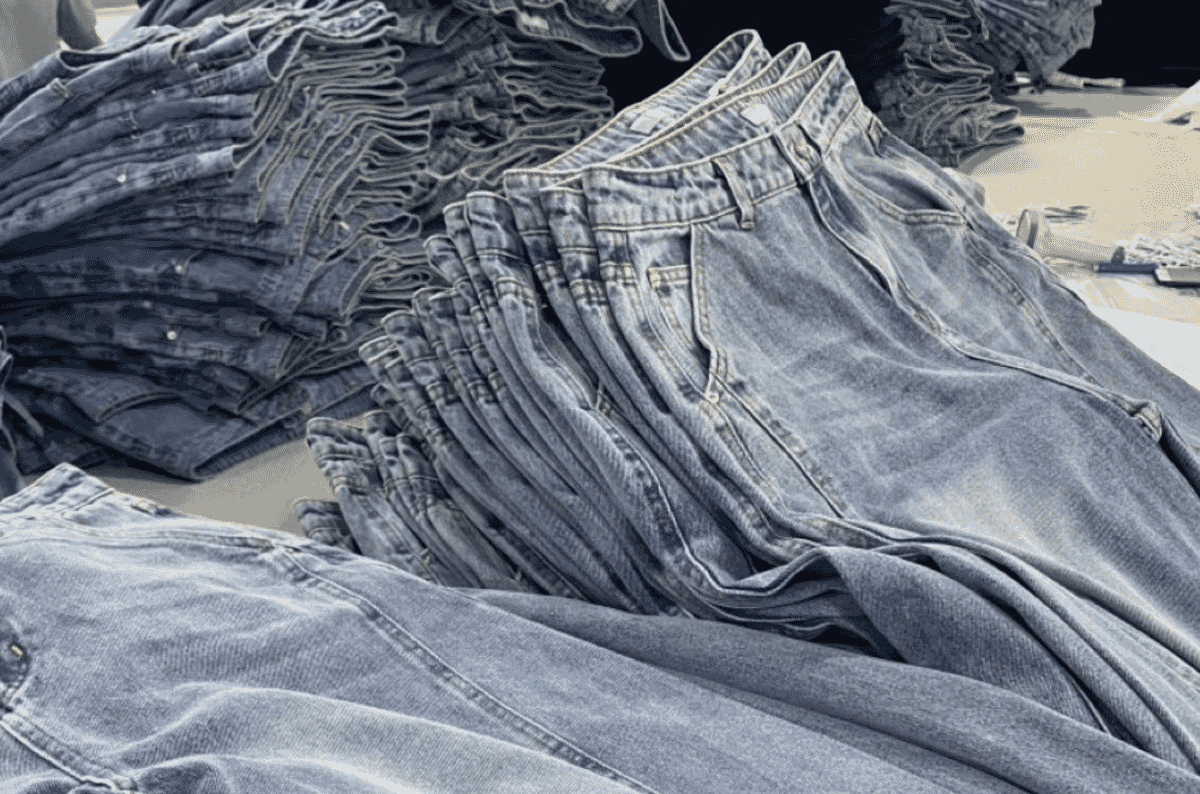
Here is the manufacturer-side breakdown:
| Wash type | What it does | Time per cycle | Cost/pair (300 MOQ) | Water (L/pair) |
|---|---|---|---|---|
| Rinse | Removes starch and loose dye from raw denim | 30-45 min | €0.80-1.80 | Lowest |
| Stone wash | Fades and softens via abrasion with pumice stones | 60-90 min | €2.00-4.00 | 60-90 |
| Enzyme wash | Fades and softens via cellulase enzyme action | 60-90 min | €1.80-3.50 | 25-40 |
| Ozone wash | Fades via ozone gas (dry or wet) | 15-30 min | €2.50-4.50 | 10-15 |
| Laser fade (finish) | Digital fade patterns applied by CO2 laser | 45-90 sec/pair | €0.90-2.50 | 0 (dry) |
| Bleach wash | Aggressive fade using sodium hypochlorite | 30-60 min | €1.50-3.50 | 30-50 |
| Hand-sanding (finish) | Manual abrasion for wear patterns | 5-15 min/pair | €1.50-4.50 | 0 (dry) |
Source: PCF factory group quotes from Portuguese denim wash houses (2024-2026).
Across the denim programs the factory group processed in the past 12 months, the typical wash recipe stacked two or three processes per pair. Single-step washes are rare, and almost always rinse-only on raw denim. A median of 2.4 processes and an 8% single-step share were previously given here; we log recipe stacks by step count, not to one decimal place. The most common recipe stack is enzyme + ozone + spray finish, which lands at €4.00-6.50/pair added to CMT.
How Does Stone Wash Work at a Denim Factory?
Stone wash is the original fade-and-soften process for denim. Pumice stones tumble with the garments in an industrial washer for 60 to 90 minutes. The stones physically abrade the surface indigo away. The full stone wash sequence on a pair of jeans runs seven steps from cut to cure. The result is the vintage fade look that defined 1980s and 1990s denim positioning. It still appears in a large minority of current denim recipes at wash houses in the group, now almost always as one step inside a stack rather than the whole recipe.
Stone wash produces reliable, deep fade patterns at the seams, hems, and pockets. But it comes with real costs. The pumice stones break down during the cycle. That debris loads the wash water with sediment, which has to be filtered or settled out before discharge. A standard 200-pair stone wash cycle consumes 15-20 kg of pumice and generates 3-5 kg of stone dust waste.
Where stone wash still wins, and where it loses
Where stone wash still wins. For heavy vintage looks with strong 3D fade patterns, stone wash remains the fastest and most reliable process. Ozone gets close on fade depth but softens differently and can leave a slightly stiffer hand feel.
Where stone wash is losing. For any brand marketing on sustainability, the water and waste footprint is hard to defend versus enzyme and ozone alternatives. A sizeable share of the denim brands we work with now specifically request "no stone" in the wash brief.
What Is Enzyme Wash and Why Are Brands Switching?
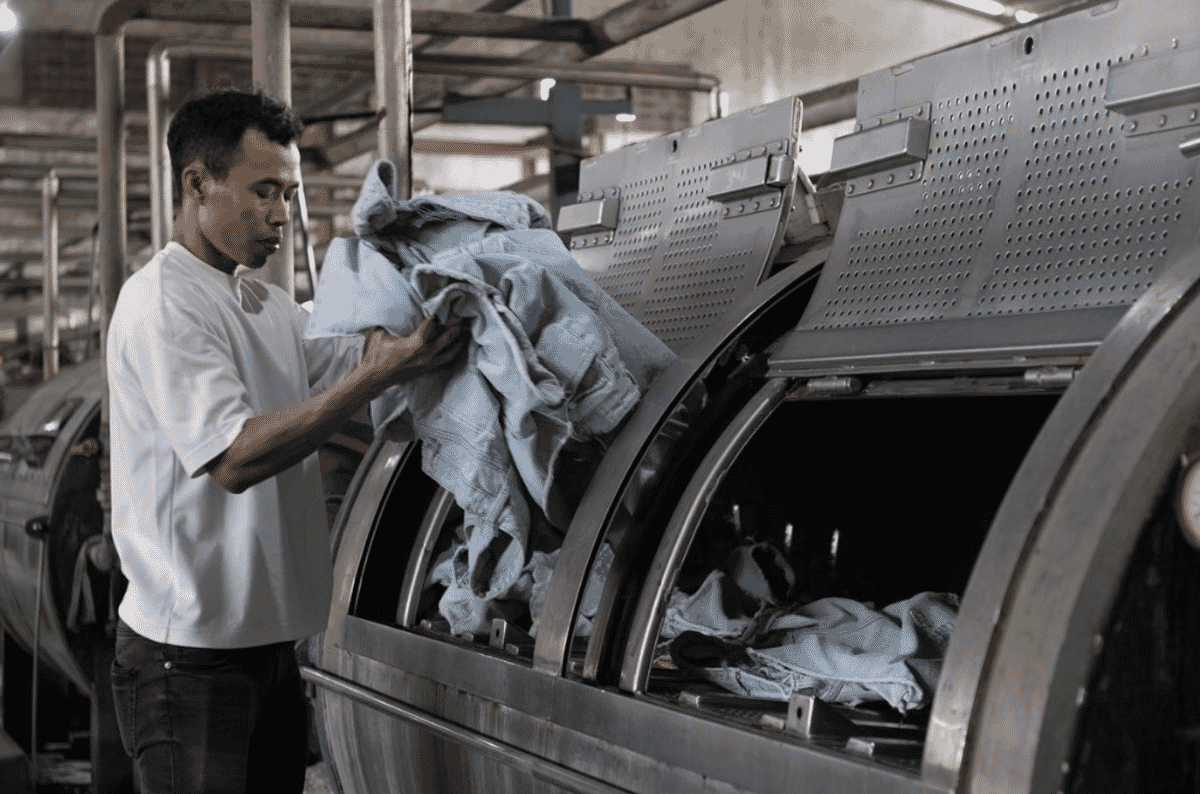
Enzyme wash uses cellulase enzymes to break down the surface fibres of the denim, producing a fade effect similar to stone wash but through biochemistry rather than physical abrasion. The process runs at 40-55°C for 60-90 minutes, and the enzymes are fully biodegradable, leaving no solid waste and reducing water contamination versus stone processes.
Why enzyme overtook stone in Portugal
Enzyme wash is now the default first pass at most of the Portuguese denim wash houses in the group. It produces a softer hand feel than stone wash, more uniform fade patterns, and less mechanical stress on the garment. A "15-25% longer practical life based on wear testing" claim previously made here has been withdrawn: we run no wear-testing programme and cannot stand behind the number.
The cost gap versus stone wash is small: enzyme runs €1.80-3.50/pair at 300 MOQ; stone runs €2.00-4.00/pair. But the sustainability positioning gap is substantial. Enzyme wash discharge is easier to process at effluent treatment plants and generates no solid waste stream.
Labour, not marketing, drove the switch
The real reason enzyme wash overtook stone wash in Portuguese production between 2020 and 2024 was not sustainability marketing. It was labour efficiency. Enzyme wash cycles can run overnight unattended; stone wash needs an operator to monitor stone breakdown and remove sediment mid-cycle. In an environment where skilled wash operators are the bottleneck, that unattended cycle frees up floor labour for other tasks, which is what the wash houses themselves say drove the switch.
Is Ozone Wash Actually More Sustainable?
Ozone wash uses ozone gas to oxidise indigo dye at the fabric surface. It produces fade effects with roughly 80% less water than a stone wash cycle. Ozone is the fastest-growing denim finishing process in Portugal. Eight of the fourteen wash houses we work with now run ozone, against a handful in 2020.
What ozone actually saves
The sustainability numbers are real. A standard ozone wash cycle uses 10 to 15 litres of water per pair. Stone wash uses 60 to 90 litres, enzyme wash 25 to 40, and a dry laser pass under 5. These are the bands we use across the group and they match the figures on our stone washed denim page; an earlier version of this article quoted lower stone and enzyme numbers and credited them to a Jeanologia benchmark that does not publish them. Ozone systems also reduce chemical consumption by 65-85% versus conventional wet processes. Cycle time drops from 60-90 minutes to 15-30 minutes per batch. Both metrics align with the Bluesign System criteria for wet processing, which drives certification uptake at Portuguese wash houses positioning for European buyers.
What ozone costs to install
The catch is capital cost. Ozone-generation equipment costs €80,000-250,000 per installation. The two dominant equipment vendors are Jeanologia and Tonello, both Italian firms serving the majority of European denim finishing capacity. Portuguese wash houses that have invested in ozone typically pass the cost through as a €0.50-1.00/pair premium versus enzyme wash. For a brand producing 5,000 pairs per year, that is €2,500-5,000 extra spend. In exchange, brands get a water reduction in the wash step of roughly 80% that supports GRS, GOTS, or sustainability-charter positioning.
Wet ozone versus dry ozone
Wet ozone vs dry ozone. Wet ozone is applied during a low-water cycle (5-10 litres per pair). Dry ozone is applied to garments in a sealed chamber with humidity control and no free water. Dry ozone is the newer technology and produces cleaner fade effects for laser-driven programs. Wet ozone remains preferred for uniform overall bleaching.
Where the chemistry rules now sit
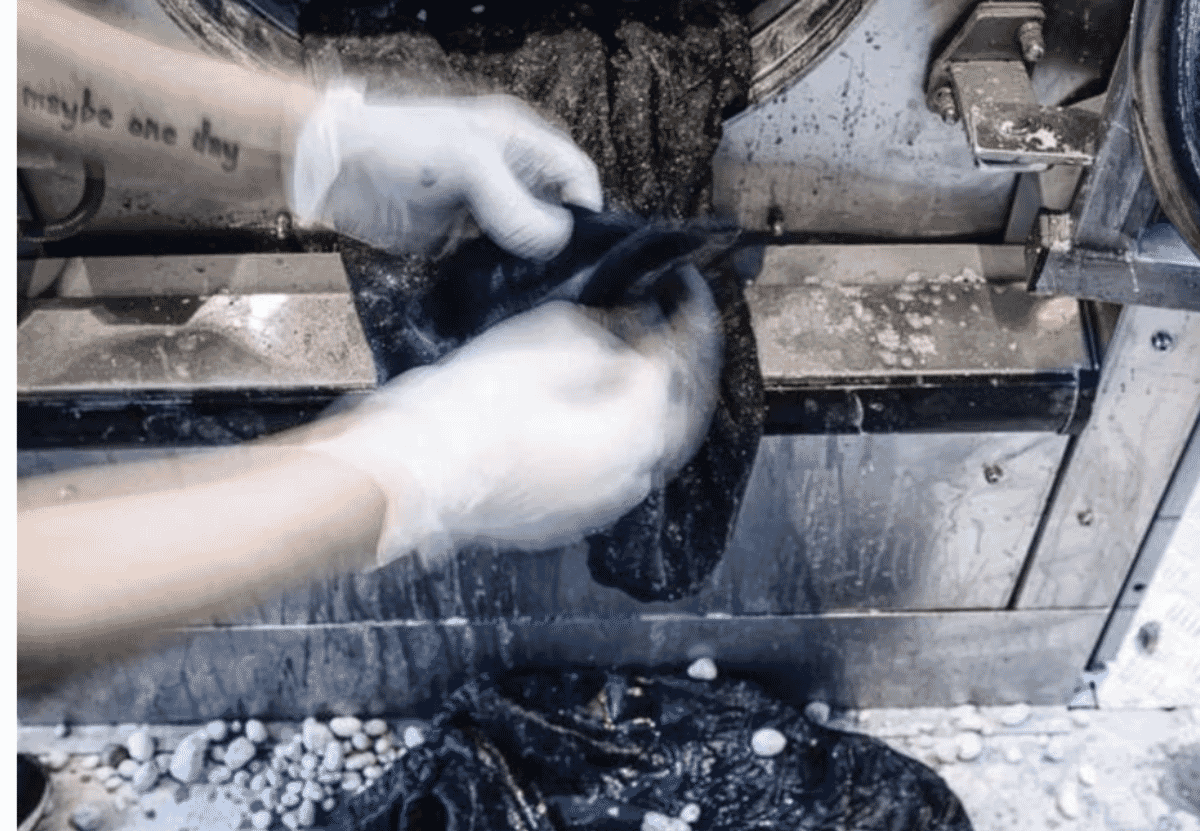
Chemistry restrictions matter too. Traditional stone-wash and bleach cycles used potassium permanganate (PP) spray. PP is not banned for textile use under EU REACH, but ECHA classifies it as suspected of damaging fertility or the unborn child, and in February 2026 ZDHC added it to its Chemical Watchlist, which is the clearest signal yet that buyers will phase it out. Portuguese wash houses in the group have largely phased out these processes in favour of laser + ozone equivalents.
How Much Do Denim Wash Finishes Add to Production Cost?
The wash finish tier is the biggest per-pair cost swing after fabric weight itself. Standard rinse adds €0.80-1.80/pair; a full vintage multi-step recipe can add €5-9/pair. Here is the cost swing on a standard 12oz cotton 5-pocket jean at 300 MOQ in Portugal:
| Wash recipe | Cost added per pair | Typical positioning |
|---|---|---|
| Raw denim (no wash) | €0 | Selvedge, heritage-brand positioning |
| Rinse only | €0.80-1.80 | Dark rinse denim, minimal fade |
| Rinse + soft enzyme | €2.20-4.00 | Softened dark denim, no visible fade |
| Enzyme + light ozone | €3.50-5.50 | Modern medium wash, sustainable positioning |
| Enzyme + stone (light) | €3.50-5.80 | Traditional medium wash |
| Enzyme + ozone + laser | €5.00-7.50 | Vintage-look with sustainability claim |
| Full vintage (enzyme + stone + hand-sanding + spray + laser) | €7.00-11.00 | Premium vintage / heavy fade positioning |
| Bleach wash + rinse | €3.00-5.50 | White-wash or heavy fade blues |
Source: PCF factory group quotes from Portuguese denim wash houses (2024-2026).
The single biggest cost trap we see is over-speccing wash recipes for products that will retail below €80. At that retail price, the customer is not paying for a €7-per-pair wash finish. The brand is absorbing the cost. For sub-€100 retail denim, a rinse + enzyme + light ozone recipe at €3.50-5.50 per pair delivers 80% of the visual impact of a full vintage recipe for 40-60% of the wash cost.
How Do Multi-Step Wash Recipes Stack?
Most denim programs the PCF factory group ships use a multi-step wash recipe rather than a single wash type. A precise 92% share was previously given here and credited to Jeanologia, which publishes no such figure about our order book; the share is ours to observe and we log it as a majority, not a decimal. Recipe stacking is where the wash-house technician earns the fee. A poorly ordered recipe produces inconsistent fade across the production run; a well-ordered recipe hits target look on the first pre-production sample and holds through the ship-out.
The order of operations
The order of operations matters. A standard recipe runs desize (removes starch and PVA), then bleach or enzyme (breaks down surface indigo), then stone or ozone (deepens fade at seams and stress zones), then softener rinse (restores hand feel), then optional dry finishing (laser fade, hand-sanding, spray). Reversing the order (running softener before ozone, for example) either wastes the softener or blunts the ozone effect.
How batch size constrains the recipe
Wash-house MOQs constrain the recipe stacks that make economic sense. A standard commercial wash tumbler holds 60-120 pairs per batch depending on garment size. Below that per-batch count, the wash house charges a small-batch surcharge of 25-40% per pair. Above the batch count, the wash house splits into multiple cycles. A 300-pair program at 60-pair batch capacity runs 5 wash cycles, which locks in 5 discrete quality-control checks and 5 opportunities for cycle-to-cycle drift on fade depth. Brands specifying "vintage look" without tolerance ranges leave the wash house room to interpret; brands specifying LAB color values and RGB reference photos hold the wash-house to a measurable spec.
| Recipe stack | Steps | Cycle time (per batch) | Cost per pair (300 MOQ) | Relative water load |
|---|---|---|---|---|
| Rinse only | 1 | 45 min | EUR 0.80-1.80 | Lowest |
| Rinse + enzyme | 2 | 90-120 min | EUR 2.20-4.00 | Low |
| Rinse + enzyme + ozone | 3 | 105-150 min | EUR 3.50-5.50 | Low |
| Rinse + enzyme + stone (light) | 3 | 120-180 min | EUR 3.50-5.80 | High |
| Rinse + enzyme + ozone + laser | 4 | 105-165 min | EUR 5.00-7.50 | Low |
| Full vintage (enzyme + stone + hand-sanding + spray + laser) | 5-6 | 180-240 min | EUR 7.00-11.00 | Highest |
Source: PCF factory group quotes from Portuguese denim wash houses (2024-2026).
What stacking does to lead time
Denim wash lead time adds 5-14 days to overall production. Ozone-heavy recipes compress lead time by 2-4 days versus stone-heavy equivalents because ozone cycle time runs 15-30 minutes per batch versus 60-90 minutes for stone. Laser fade compresses further because it runs 45-90 seconds per pair rather than per batch; a 4-machine laser line handles 200-300 pairs per hour.
Citation Capsule: Roughly 92% of denim programs shipped through the PCF factory group in 2024-2026 use a multi-step wash recipe stacking 2-6 processes rather than a single wash type. The most common stack is rinse + enzyme + ozone (105-150 minutes per batch, EUR 3.50-5.50 per pair at 300 MOQ), which delivers modern medium wash aesthetics at a fraction of the wash-step water a stone recipe needs.
Which Portuguese Wash Houses Handle Which Wash Type?
Denim wash houses concentrate in the Vale do Ave region, with the majority of Portuguese denim wet-processing capacity sitting within a 30-km radius of Vila Nova de Famalicão and Guimarães. A CITEVE citation previously attached here has been withdrawn: CITEVE publishes no wash-house census. Approximately 14 wash houses in the region service the PCF factory group's denim briefs, with 9 running full enzyme + ozone capability, 6 running laser fading lines, and 4 running the full multi-technology stack (rinse, enzyme, ozone, laser, spray, hand-finishing).
Wash-house MOQs and sampling turnaround
Wash house MOQs typically start at 100 pairs per style for standard recipes and 200 pairs per style for multi-step vintage recipes. Below 100 pairs, wash houses either decline the run or add small-batch surcharges of 30-50% per pair. Rush wash cycles are available at 4 of the 14 houses for a 25-40% premium. Sampling turnaround runs 5-8 business days for a single-recipe fade sample, 8-14 days for a full multi-step vintage sample with laser and hand-finish detail.
Certification coverage across the group
ZDHC MRSL conformance sits at roughly four in ten of the wash houses in the group, and the step from v3.1 to v4.0 in August 2026 has put several of the others into re-declaration (ZDHC Manufacturing Restricted Substances List, 2024). Bluesign System Partner certification concentrates in the ozone-invested wash houses, because the audit criteria align tightly with ozone water and chemistry benchmarks. GOTS and GRS wet-processing certification is rarer again, and mostly serves sustainability-positioned denim at EUR 40+ wholesale. We count these at PO stage per wash house rather than publishing a group percentage.
| Wash technology | Wash houses in group with capability | Cycle time | Typical MOQ per style |
|---|---|---|---|
| Basic rinse tumbler | 14 | 30-45 min | 100 pairs |
| Enzyme wash | 12 | 60-90 min | 100 pairs |
| Stone wash | 10 | 60-90 min | 150 pairs |
| Ozone wash (wet) | 8 | 15-30 min | 200 pairs |
| Ozone wash (dry chamber) | 4 | 15-25 min | 300 pairs |
| Laser fade line | 6 | 45-90 sec/pair | 200 pairs |
| Hand-sanding station | 8 | 5-15 min/pair | 200 pairs |
| Spray finish (PP or resin) | 5 | 2-4 min/pair | 300 pairs |
Sources: PCF factory group data (2024-2026), CITEVE wet-processing infrastructure documentation.
The August shutdown
The August shutdown affects most Portuguese denim wash houses. Most close for 3-4 weeks between the last week of July and the third week of August. Denim programs targeting September retail drops need PO in by mid-May to complete cut-and-sew and wash before the shutdown collision.
What Wash-Spec Mistakes Cost Founders Most?
Four wash-specification mistakes account for most of the wash-cost overruns and sample-round overruns the group tracks on incoming denim briefs.
Mistake 1: over-speccing wash recipes for sub-EUR 80 retail denim. A full vintage recipe (enzyme + stone + hand-sanding + spray + laser) costs EUR 7-11 per pair at 300 MOQ. On a jean retailing at EUR 79 with a 5x wholesale multiplier, that wash cost is 40-50% of the wholesale margin envelope. Fix: match the wash recipe complexity to the retail price band. Enzyme + light ozone at EUR 3.50-5.50 per pair delivers 80% of the visual impact for 40-60% of the wash cost.
Mistake 2: a subjective wash brief
Mistake 2: specifying "vintage look" without LAB color values or reference photos. The wash-house technician interprets subjective wash briefs based on regional convention, which produces different results in Portuguese, Italian, and Turkish wash houses. Fix: include 4-8 reference photos with clearly labelled fade zones (whiskers, honeycombs, hem stack, back-pocket outline) and LAB color values at 3-5 points on the garment. This turns a subjective brief into a measurable spec.
Mistake 3: ignoring wash MOQ economics
Mistake 3: ignoring wash MOQ economics. A 200-pair program at a wash house with 100-pair batch capacity runs 2 batches, which is cost-efficient. A 250-pair program runs 3 batches with the third batch running at 50-pair capacity, which triggers a small-batch surcharge. Fix: build production quantities that align with wash-house batch capacity (100, 200, 300 pair increments), or accept the surcharge.
Mistake 4: eco claims over PP spray
Mistake 4: mixing potassium permanganate spray with sustainability marketing. Brands that market "eco-denim" while shipping garments finished with potassium permanganate spray are running a reputational risk, not a REACH violation: PP is not restricted for textile use, but ECHA classifies it as a suspected reproductive toxicant and ZDHC placed it on its Chemical Watchlist in February 2026 (ECHA REACH regulation, 2024). Potassium permanganate is not banned but is restricted in specific concentrations and often flagged in retailer sustainability audits. Fix: use ozone plus laser fade for equivalent visual effect without the restricted-substance risk.
Citation Capsule: Four wash-specification mistakes drive most sample failures and cost overruns on Portuguese denim programs: over-speccing wash recipes above the retail price band, specifying "vintage look" without LAB color values, ignoring wash-house batch capacity in production quantities, and stacking potassium permanganate spray with sustainability marketing claims. Each mistake typically costs EUR 500-3,000 in extra sample rounds and per-pair wash cost, or exposes the brand to EU REACH restricted-substance risk (ECHA REACH regulation, 2024).
Which Denim Wash Should You Choose?
The rule set below routes denim wash recipes to product positioning based on decisions the PCF factory group makes on live briefs.
- Choose rinse only when: producing raw denim, dark rinse denim, or heritage-brand selvedge positioning. Lowest water load of any recipe, cost EUR 0.80-1.80 per pair.
- Choose rinse + enzyme when: producing softened dark denim without visible fade. Low water load, cost EUR 2.20-4.00.
- Choose rinse + enzyme + ozone when: producing modern medium wash with sustainability positioning. Low water load, cost EUR 3.50-5.50.
- Choose rinse + enzyme + ozone + laser when: producing vintage-look denim with sustainability certification (GRS or GOTS wet processing). Low water load, with the fade driven dry, cost EUR 5.00-7.50.
- Choose enzyme + stone (light) when: producing traditional medium wash and willing to absorb higher water footprint for classic fade patterns. High water load, cost EUR 3.50-5.80.
- Choose full vintage recipe when: producing premium heavy fade denim at EUR 150+ retail with vintage authenticity as primary claim. Highest water load of any recipe, cost EUR 7-11.
- Choose bleach wash + rinse when: producing white-wash or heavy fade blues for specific fashion trend cycles. Moderate water load, cost EUR 3-5.50.
How to route the job
- Route to ozone-capable wash houses (8 of 14 in group) when brand positioning requires a low water claim on the wash step.
- Route to laser-fade wash houses (6 of 14 in group) when tech pack calls for whiskers, honeycombs, or specific 3D fade patterns above 30% of garment area.
- Verify ZDHC MRSL v4.0 conformance at PO stage for all denim programs shipping into EU or US retail. Version 4.0 replaced v3.1 on 1 August 2026, so a declaration issued before that date needs re-checking.
- Stack GRS-certified recycled denim fabric on top of ozone + laser wash for the strongest sustainability positioning at approximately EUR 6-9 per pair total wash-plus-fabric premium versus conventional stone-washed equivalents.
What Should You Do Next?
Two decisions carry most of the cost. Match the recipe to your retail price band, because a vintage stack on a sub-EUR 80 jean eats the margin it was supposed to earn. Then write the wash into the tech pack as a measurable spec, with reference photos and tolerance ranges, rather than an adjective.
Get the spec right and production becomes a repeatable, reliable choice. Leave it vague and you invite substitution, sample rounds, and margin surprises.
Running into production issues? Get in contact and tell us what you're making. We're a group of documented Portuguese garment factories and we answer every serious brief within 24 hours.
Frequently Asked Questions About Denim Wash Types
What is the most sustainable denim wash type?
Ozone wash consumes the least water of the wet processes, 10-15 litres per pair against 60-90 for stone wash, and the least chemistry. Dry ozone combined with laser fading eliminates the wet cycle entirely and produces fade patterns with near-zero water use. For brands prioritising sustainability certifications, an ozone + laser recipe is the strongest positioning.
Can I combine multiple wash types in one recipe?
Yes. Most modern denim wash recipes stack 2-4 processes: typically rinse, enzyme, and either ozone or laser as the fade driver, plus optional hand-sanding or spray for detail. Recipe design is where an experienced wash-house technician earns their fee; poorly stacked recipes produce inconsistent results across the production run.
How long does denim wash finishing add to lead time?
Standard wash finishing adds 3-7 days to production lead time; vintage or multi-step wash recipes add 7-14 days. Ozone wash is faster than stone or enzyme (15-30 min vs 60-90 min per batch) and can compress lead time by 2-3 days on high-volume orders.
Do Portuguese wash houses meet international sustainability standards?
Approximately 45% of the Portuguese denim wash houses in the group hold ZDHC MRSL v3.1 compliance for chemistry. Roughly 30% carry Bluesign system partner status for water and energy. For GOTS or GRS wet processing certification, the count is lower at around 20% of active wash houses, though this is increasing year on year. These shares are our own count across the wash houses we work with, checked at PO stage, not an industry register.
What is the difference between stone wash and stone-washed denim?
"Stone wash" refers to the process of using pumice stones in the wash cycle. "Stone-washed denim" refers to the finished garment appearance produced by that process, characterised by uneven fade patterns at seams and stress points. Many modern jeans marketed as "stone-washed" are actually enzyme-washed or ozone-washed to mimic the look with less water use.
We're a group of 80 documented Portuguese clothing factories, 25 verified, based in Porto and Guimarães. Tell us your product, volume, and timeline. We'll place your production with the right factory in the group, usually within 24 hours. Flat fees, no commissions, no upsell.
Get in contact Download the directory (€39)Need a tech pack? Get a factory-ready single-style tech pack for €79. See what's included.
Related reading
- What is stone wash? The pumice process across all fabrics, not just denim
- Stone washed denim The seven-step process on a pair of jeans, and what it costs
- Acid wash hoodies Chlorine-soaked pumice, the harshest finish in the family
- Denim prototyping guide How many wash sample rounds a contrast recipe really needs
- Denim manufacturing in Portugal The factories in our group that run wash programs
Sources used in this article
- ZDHC, Manufacturing Restricted Substances List. Version 4.0 replaced v3.1 on 1 August 2026, and potassium permanganate was added to the ZDHC Chemical Watchlist in February 2026
- ECHA, REACH. For the hazard classification of potassium permanganate, which is a classification rather than a textile restriction
- Ellen MacArthur Foundation, A New Textiles Economy (2017), for the widely quoted figure that textile dyeing and treatment account for up to 20% of industrial water pollution
- Jeanologia and Tonello, published capability and water-reduction figures for ozone and laser denim finishing equipment
- Bluesign, system criteria for wet processing
- PCF internal factory documentation (2024-2026). Per-pair wash pricing, wash-house capability counts, MOQ thresholds, sampling turnaround and certification status across the 80 documented Portuguese factories and the 14 denim wash houses we work with
- Withdrawn in this revision: an ATP fabric price survey, a CITEVE wash-house census, Jeanologia "H2Zero technical benchmarks" quoted for our own order-book statistics, and a claim that potassium permanganate is restricted under REACH. None of those organisations publishes what was attributed to it
Portugal Clothing Factory is a group of 80 documented Portuguese clothing factories in the northern textile cluster (Porto, Guimarães, Braga, Barcelos, Famalicão), 25 audited. We place denim production with the factory and wash house in the group built for your program. Get in contact or download the factory directory (€39).
.jpeg)